Students from the University of Tennessee recently took part in a competition hosted by the Center for Regional and Rural Connected Communities (CR2C2) and made possible by a contribution from Honda to develop data-driven solutions to improve rural transportation systems.
The students were tasked with leveraging data-driven insights to improve roadway safety and reduce serious injuries and fatalities in rural Tennessee. The teams worked with rural crash data and seat belt use data from Tennessee. The competition was open to UT undergraduate and graduate students from any major.
The first-place team, which received $3,000, was comprised of civil engineering graduate students Xinyu Hu, Mohammad Khojastehpour, and Zeinab Bayati. The team’s project was titled, “A Data-Driven Analysis of Injury Severity in Rural Crashes.”

The project looked at rural crash data in Tennessee to better understand what affects how severe injuries are, especially focusing on seatbelt use. The team combined and cleaned multiple datasets, explored patterns through descriptive and spatial analysis, and used a statistical model to identify key factors like age, alcohol use, and crash type. They also created dashboards that let users test different scenarios and see how injury outcomes might change.
“For our team, winning this competition serves as a vital validation of our mission: bridging the gap between complex traffic safety data and the stakeholders who require it most—including law enforcement, researchers, and the general public,” Hu said. “To be recognized by the CEE and industry experts confirms that our approach to data-driven insights provides a practical, life-saving solution for the state of Tennessee.”
The second-place team, which received $1,500, was comprised of industrial engineering graduate students Xudong Wang, Madelaine Martinez-Ferguson, Aliza Sharmin, and Jose Tupayachi Silva. The team’s project was titled, “Data-Driven Identification of Roadway Safety Challenges in Rural Tennessee.”

The project analyzed crash data and seatbelt usage across rural Tennessee to identify where and why severe crashes are happening. The team combined large crash datasets with observational seatbelt data, applied statistical and machine learning methods, and mapped patterns across counties to pinpoint high-risk groups and locations. They found strong links between lower seatbelt use and higher fatality rates, especially among pickup drivers and in specific outcomes.
The third-place place team, which received $1,000, was comprised of civil engineering students Riley West, Manuela Cordoba-Misas, Isaiah Rajnoor, and David Bushayija. The team’s project was titled, “Safer Rural Transportation Systems.”
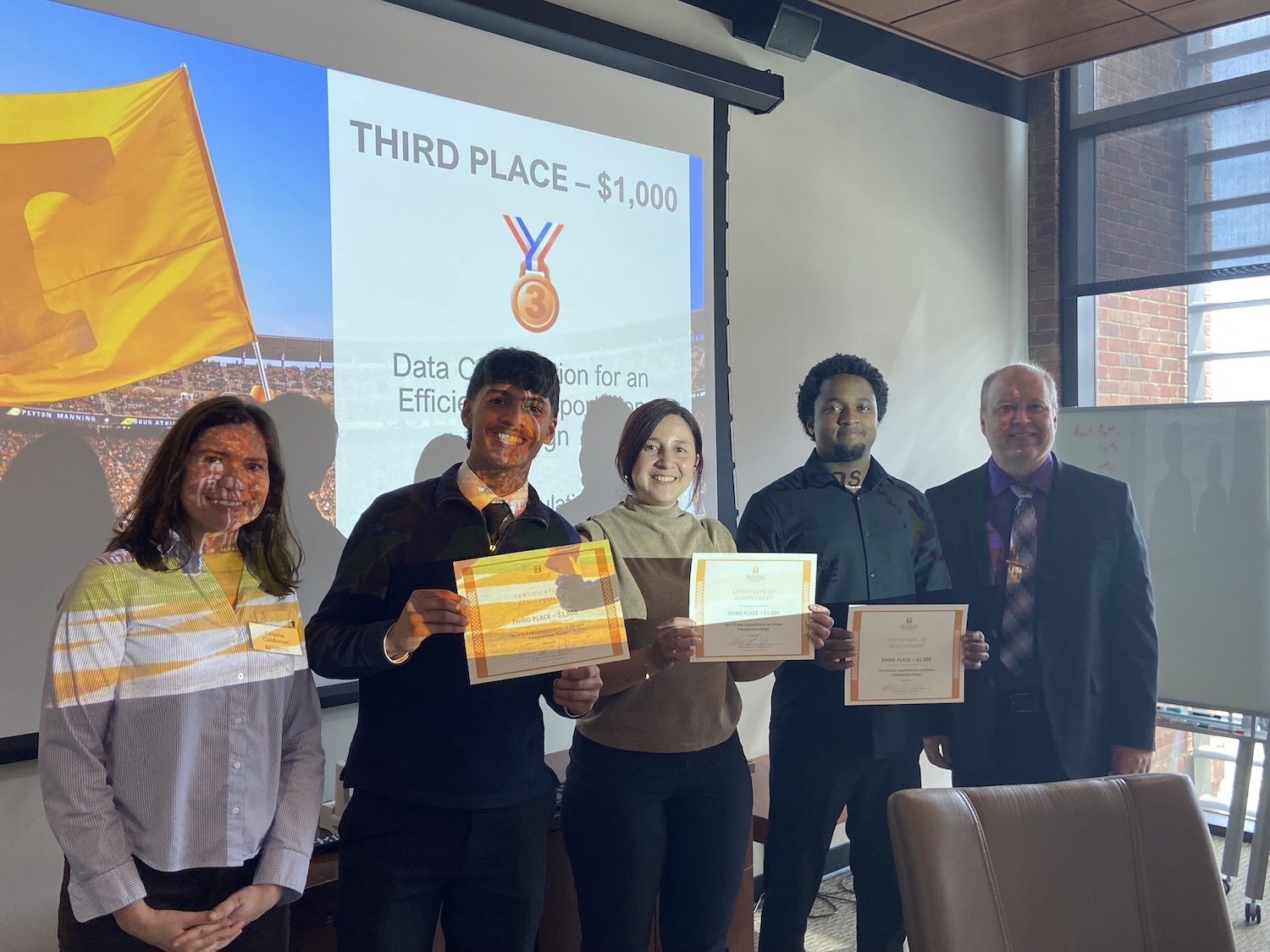
The project analyzed rural crash patterns in Tennessee by combining crash data and seatbelt information and looking at how risk vary across locations. The team used spatial modeling to identify where factors like lighting, weather, traffic exposure, and driver age contributed most to crashes, and compared these with seatbelt usage patterns to find high-risk groups and counties. Their results showed that crash risk are not uniform and depend on local conditions and behaviors.
CEE Assistant Professor Oriana Calderon and Airton Kohls, a research assistant professor in the Center of Transportation Research (CTR) led the competition. The panel of judges were Christopher Osbourn, TITAN program coordinator for the Tennessee Highway Patrol; Matthew Cate, director of the Tennessee Transportation Assistance Program, CTR; and Kohls.
Hu’s team plans to incorporate the valuable feedback they received at the competition to improve their tool’s interactivity and AI extension capabilities.
“Our broader objective is to contribute to Tennessee’s standing as a leader in traffic data visualization,” Hu said. “Platforms such as TN-TIMES and SmartwayTN already provide superior traffic information visualization compared to many other states. We intend to build upon this foundation by demonstrating how specific variables—such as seat belt usage, seating position, and ‘manner of collision’—can be visualized to better inform public education and law enforcement strategies.”
Contact
Rhiannon Potkey ([email protected])