A Reef that Starts at the “Drop Off”
Department of Civil and Environmental Engineering (CEE) senior Ben Holley appreciates how small actions can create big impact.
“It’s the little things that I really enjoy doing,” he said. “It’s helping my friends with homework or doing the dishes when I go over to my parents’ house. Just the little things to make people’s day slightly better.”
Holley also loved building with Legos as a child. When he came to the University of Tennessee and saw CEE lab students creating and destroying concrete blocks, he knew he had to try building at the college level.
As he got further into his degree program, Holley discovered a passion for civil engineering that goes beyond the bricks.
“I started to learn how much good I can do with civil engineering,” he said. “You can make everything more sustainable or make housing more affordable. I really want to make the world a better place while I’m in it, so it was like, ‘I can still help people while doing something I enjoy.’”
Holley has gotten to experience firsthand how fast a civil engineer’s ‘little things’ add up to big impacts through his CEE senior design project, advised by CEE Fred N. Peebles Professor Dayakar Penumadu.

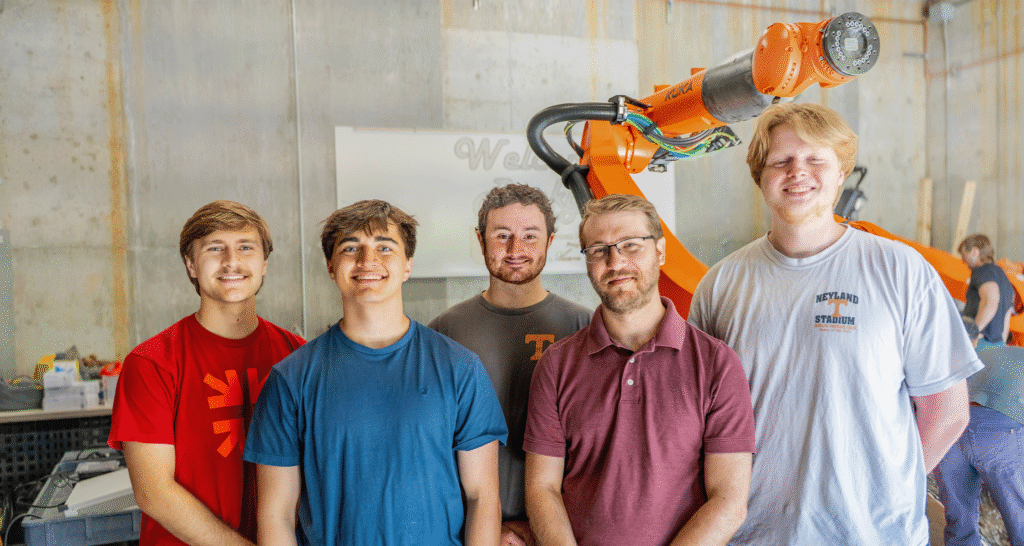
Holley’s project was sponsored by EPRI, an international nonprofit organization committed to creating a safe, reliable, affordable, and resilient global energy system. EPRI tasked Holley and his teammates—CEE seniors Aaron Kaplan, Ben Marchetti, Elijah Stage, and Ian Startup—to prototype a sustainable concrete anchor for mooring floating solar photovoltaic (FPV) systems.
Last fall they also gained sponsor support from Sperra, a company developing marine infrastructure solutions for offshore energy and aquatic environments.
“Our goal is that once the FPV systems are decommissioned, the anchors can act as artificial reefs,” Holley explained. “We’re also using recycled wind turbine blades in our concrete, so we’re making clean energy and also being environmentally friendly on top of that.”
The Recipe for an Anchor
FPV systems are often secured in place with blocky anchors made of reinforced cast-in-place concrete. When the FPV is decommissioned, the anchors must be hauled out of the seabed and towed away to dispose of or recycle at great expense.
In response to growing industry interest in scalable, lower-impact infrastructure solutions for offshore energy, EPRI challenged Holley’s team to prototype a 3D-printable anchor that could be left in place indefinitely—safely hosting marine life from the moment it was dropped.
“Our anchor is pretty special because it’s got a 3D printed concrete shell, and then we’re filling it with a cast-in-place mix,” Holley said. “The cool thing about 3D printing the shell is, you can make the anchor be basically any shape.”

Holley’s team reviewed many options for the anchor’s shape, ultimately selecting one of Sperra’s FPV anchor geometries that includes complex curves at the bottom that help the anchor better embed in the seafloor. The shape is difficult to fabricate with traditional methods, but perfect for 3D printing—and it even reflects established marine habitat guidelines, like surface complexity and hollow spaces.
To lower the cost and carbon footprint of their cast-in-place concrete filling, Holley’s team considered multiple recycled inputs including fly ash, glass beads, and recycled wind turbine blades. After narrowing down the options based on cost, predicted environmental impact, and logistical feasibility, they settled on a recipe that includes recycled wind turbine blades from Carbon Rivers.
Next, the students evaluated their proposed mix for strength and durability. They also subjected cured blocks to environmental tests, submerging them in salt water to check for metal leaching, changes in pH (acidity), and any negative effects the new concrete might have on a population of small marine shrimp.

The anchor shell was printed at UT’s Concrete Hybrid Autonomous Manufacturing Platform (CHAMP) in late April. Holley’s team cast their concrete in the center, then presented their final results at the Interdisciplinary Senior Design Showcase on May 1st.
“The fact that, in only two semesters, we have made it to the point where we’re actually going to be able to print the anchor is a very big success,” Holley said. “My teammates have become some of my closest friends, and they’re going to be great civil engineers.”
Following graduation, Holley will stay at UT and pursue his master’s degree in civil engineering. After working in the industry for several years, he ultimately hopes to earn his doctorate and become a civil engineering professor.
“A lot of people will go through college and they won’t get a research opportunity. I think having that experience gives us an extra layer of what we can do after graduating,” he said. “Knowing how to do research is just a really cool thing and will definitely help us in the future.”
Contact
Izzie Gall ([email protected])